
Component Cards
What lies beneath the ground? Meet the high-tech components of the Einstein Telescope.

Gravitational waves stretch space
Powerful cosmic events, such as the merger of black holes or the explosion of stars, release gravitational waves. These are tiny ripples in spacetime that travel towards us at the speed of light. When such a wave passes by here on Earth, space itself is stretched and squeezed, making distances ever so slightly shorter or longer.

Measuring with an interferometer
We can try to measure these differences in distance and use them to learn about the source of the gravitational wave. To do so, we use an interferometer: an instrument that cleverly splits and recombines beams of light in order to measure differences in distance. An interferometer takes a laser beam, splits it into two beams and sends them down two arms. At the start, the light beams are in phase: the light waves go up and down at the same time. At the end of each arm, the laser beams are reflected by a mirror and meet again at the corner of the detector. When the arms are exactly the same length, the laser beams have traveled exactly the same distance, so they also arrive in phase. But if one arm is just slightly longer — because of a passing gravitational wave, for example — the waves get out of phase. The light waves no longer go up and down together. We can measure this by placing a sensor at the corner of the detector, which measures the phase difference between the two light beams.

Components of the interferometer
To measure gravitational waves, you need an interferometer with arms several kilometers long. This is because the differences in distance caused by such a wave are incredibly small. Over a few kilometers, the difference is smaller than the diameter of an atom! To put that in perspective: it is like measuring the distance from here to the nearest star to within the width of a hair.
The interferometers in gravitational wave detectors must therefore be tuned extremely precisely: small vibrations, such as those caused by passing trucks, imperfections in the lasers or the heating of the mirrors, are already enough to disturb the measurement. The Einstein Telescope will do even better on all these fronts than current gravitational wave detectors. You can find the new techniques and scientific innovations that will be used in the Einstein Telescope on the component cards of Einstein's Echo.
If the Einstein Telescope is built here in Belgium, the detector will most likely take the shape of a gigantic triangle, built deep underground. Each side of this triangle will be 10 kilometers long, and at each corner there will be towers tens of meters tall. Altogether, six interferometers will be placed in the triangle: two at each corner. Of each pair, one interferometer measures high-frequency gravitational waves, and the other measures low-frequency waves. By measuring different frequencies of gravitational waves, we can listen to different cosmic sources of gravitational waves.
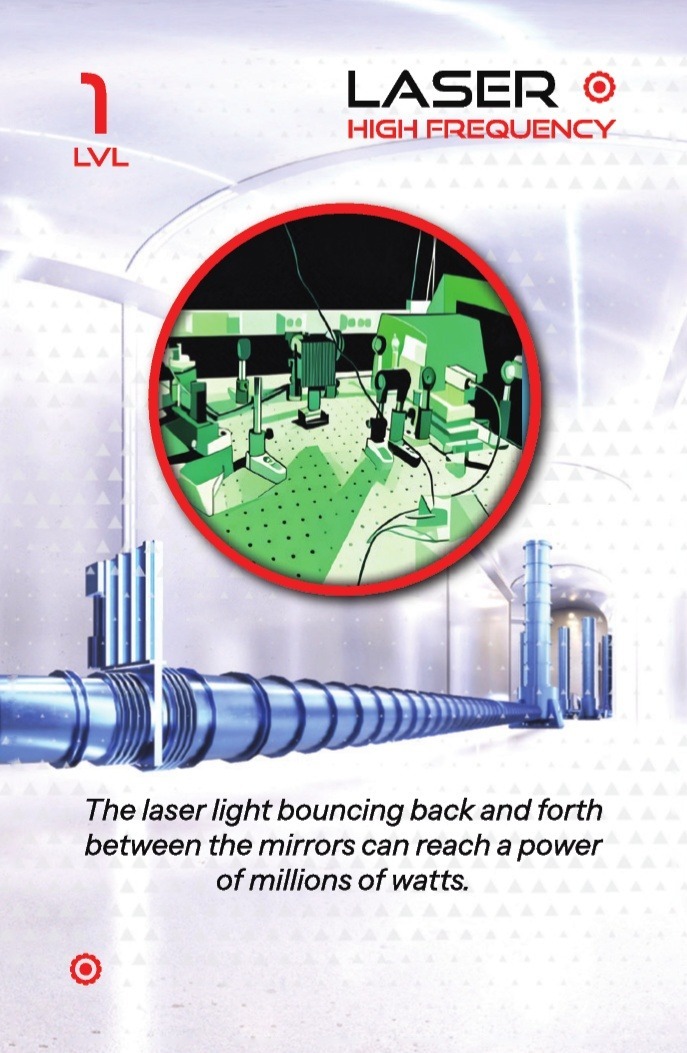
Laser
The lasers that will be used in the interferometers of the Einstein Telescope are very precisely tuned to the signals we want to measure. That is why we use two different lasers for the high-frequency and low-frequency signals. When you think of a laser, you might picture a very thin red beam of light, but in reality it is completely different. First of all, these lasers are infrared, so they are invisible to the human eye! What's more, the laser beams are about 20 cm wide. The lasers are so powerful that we have to spread their light over a wider surface; otherwise they could easily burn a hole in the equipment.

Mirror
At the end of the arms, the laser beams will be reflected by mirrors of unprecedented precision: because the differences in distance caused by gravitational waves are so small, the mirrors have to be perfectly flat. They receive multiple layers of coating, which make the surface smooth down to the molecular level. The mirrors of the Einstein Telescope are therefore a lot more complex than an ordinary mirror you buy in a shop. You couldn't even use one, because you wouldn't see your reflection in it at all! The mirrors are in fact transparent to visible light, and only reflect the infrared light of the Einstein Telescope's lasers. To limit thermal noise, the mirrors for low frequencies must also be cooled to about -260 °C!
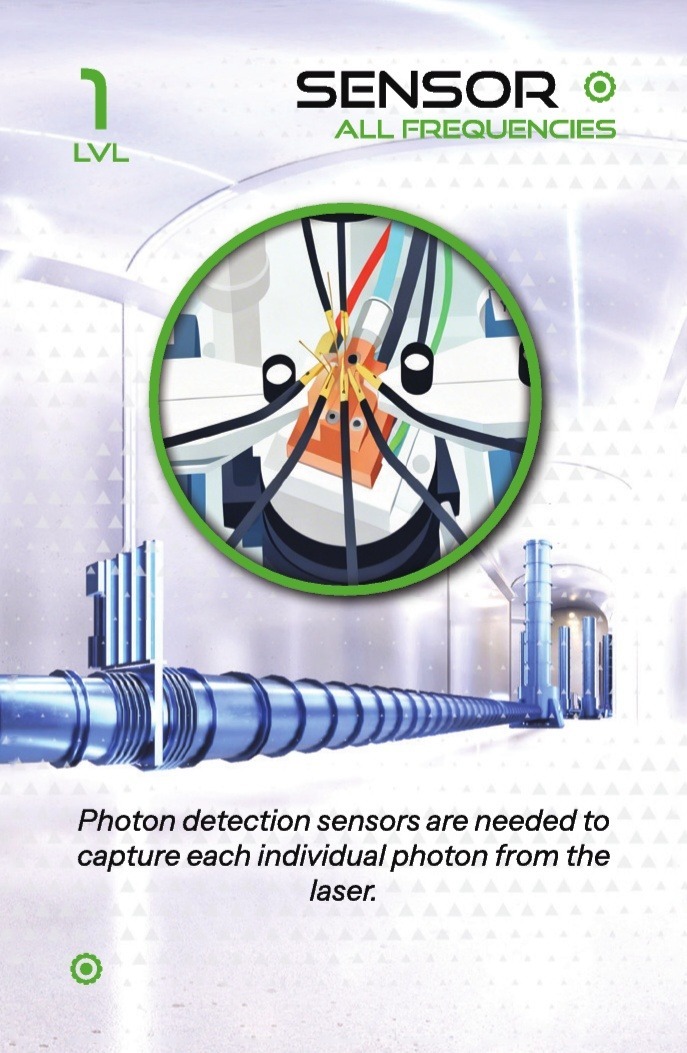
Sensor
The light beams reflected by the mirrors are then captured and combined in extremely sensitive sensors. These sensors measure the phase difference between the two light waves, to see whether a gravitational wave has made the arms slightly longer or shorter. They work like a kind of LED in reverse: the more laser light shines on them, the more electric current they generate. The Einstein Telescope will also be packed with other, similar sensors that make sure the laser keeps shining at the center of the mirror. Just try aiming a laser at a 20 cm target 10 km away!
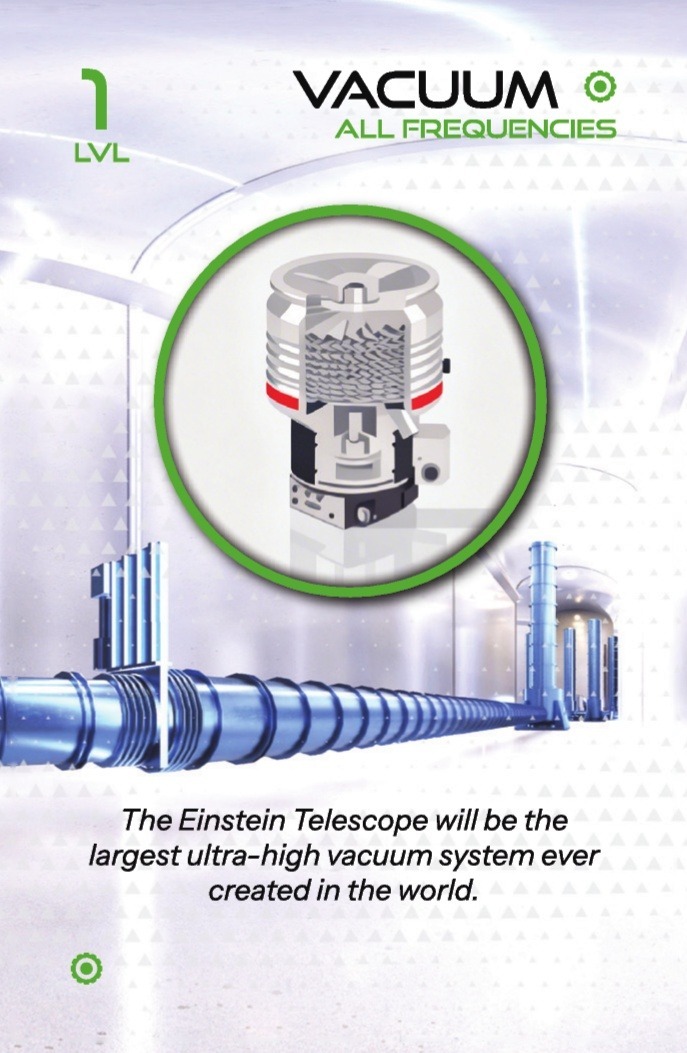
Vacuum
There are many external factors that can disturb the measurements and cause noise, so we have to do everything we can to reduce these disturbances. One source of noise is the presence of air particles in the tubes the lasers travel through. When the laser beam hits such an air particle, it is deflected. The air in the tubes therefore causes unwanted scattering of the laser. That is why the tubes through which the laser travels must hold a high-quality vacuum. All the air is pumped out of the tubes and towers until only a few air particles remain. This vacuum is so strong that the tubes have to be extra reinforced; otherwise the outside pressure would make them collapse immediately!
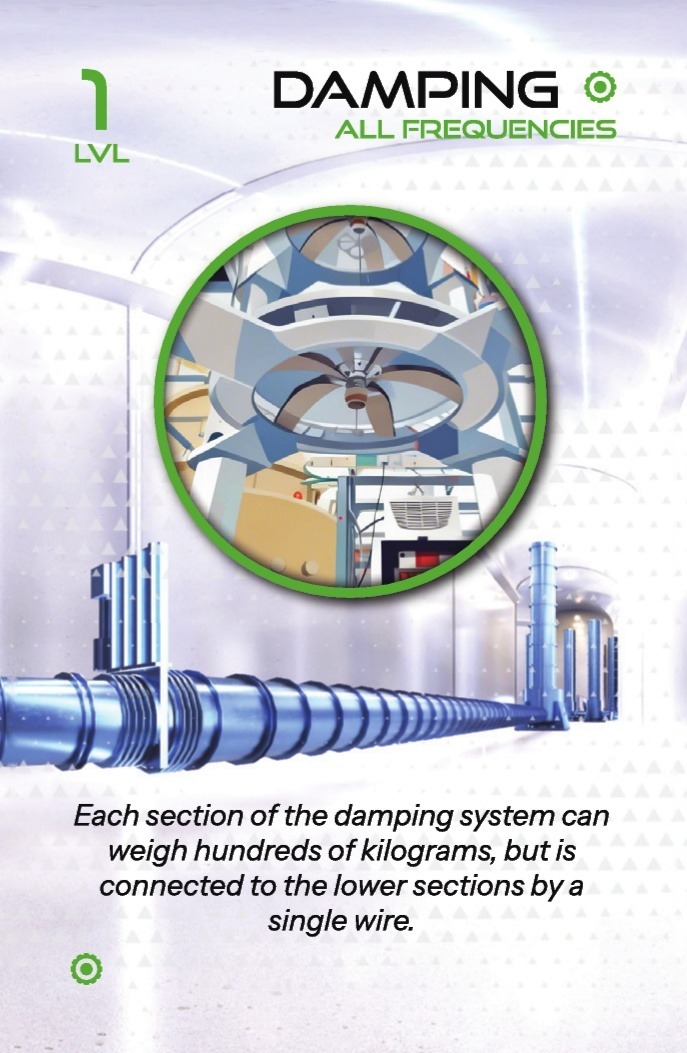
Damping
A second source of disturbance comes from vibrations in the detector. If the mirrors swayed slightly back and forth because of movements from outside, the interferometer would no longer be able to measure gravitational waves. That is why the mirrors are suspended from complex damping systems. The vibrations are damped by a chain of pendulums: heavy weights connected to each other by strong wires. Even when the walls of the detector start to vibrate, the mirror stays perfectly still. Unfortunately, the slowest vibrations cannot be damped with a pendulum. We therefore have to measure these vibrations and actively compensate for them by moving the mirrors in the opposite direction.
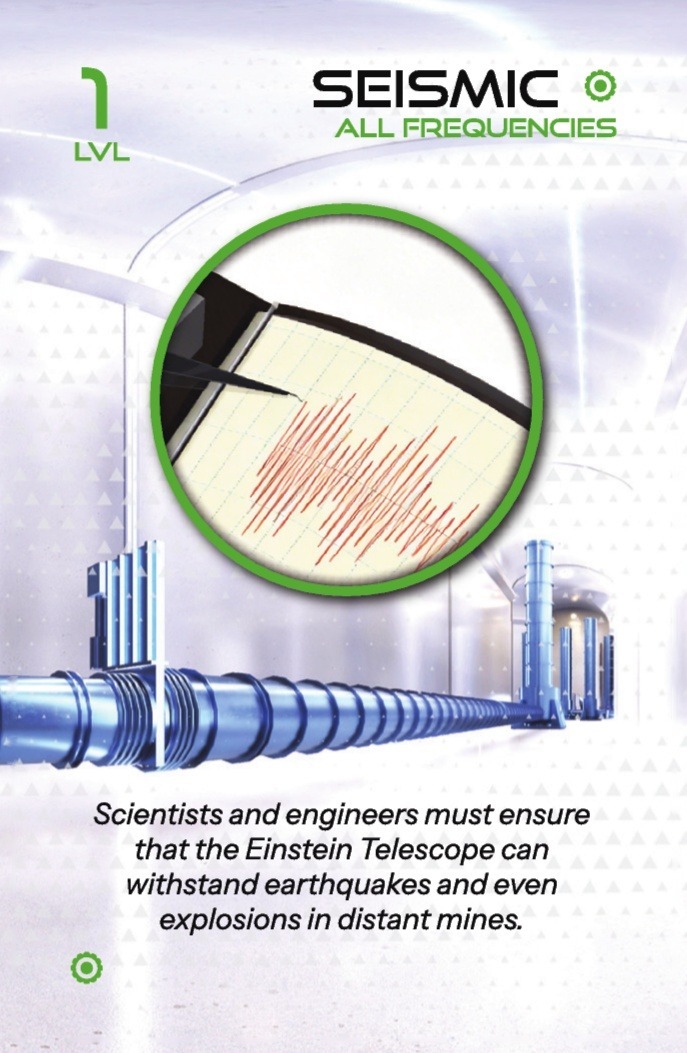
Seismic
To reduce vibrations in the detector, the Einstein Telescope will be built some 200 to 300 meters underground. The border region where Belgium, the Netherlands and Germany meet is the ideal location for this: the subsurface consists of a soft layer that dampens vibration waves well, on top of a hard layer that is solid enough to build the Einstein Telescope in. This reduces disturbances from, for example, passing trucks, wind turbines or earthquakes. Still, not all vibrations are fully damped, so all seismic activity is carefully mapped. By measuring which vibrations still reach the detector, we know what noise to expect in the signal.
Analysis
All the components above work together to measure gravitational waves as precisely as possible. The signals measured by the sensors are then ready for the final step: data analysis. First, the remaining noise has to be separated from the gravitational wave signal. From what is left, we can then try to unravel the mysteries of our universe. One of the challenges of the Einstein Telescope is also one of its strengths: with the Einstein Telescope, we will be able to measure many more signals than with current detectors. Today, gravitational wave detectors measure on average one signal per week. With the Einstein Telescope, we will measure up to a hundred signals per hour! Moreover, the low-frequency detector will be able to detect each signal for much longer. Signals from different sources will therefore overlap, and telling the different cosmic events in these signals apart will be a real challenge for data analysis.