
Event Cards
What do you hear when the universe collides? These cards show the events you try to catch in Einstein's Echo.
Gravitational waves
With the Einstein Telescope, we will measure gravitational waves produced by various cosmic events, such as those on the event cards of the card game Einstein's Echo. Many of these events are dark: they do not emit any radiation that we can measure with light telescopes. We may not be able to see such phenomena, but we can hear them through gravitational waves. Different events emit different gravitational wave signals, which makes them sound different. By listening carefully, we can therefore work out which event took place far away.

The event cards
All these signals are continuously traveling towards us from various events in the universe. With the Einstein Telescope, we will be able to listen to, study and unravel a symphony of these gravitational waves. Some signals, however, are weaker and therefore harder to measure than others. That is why it is important to make the Einstein Telescope as sensitive as possible. The events in the card game Einstein's Echo therefore each have a level, which shows how difficult it is to detect that event.
Astronomical distances and masses
All sources of noise (vibrations, thermal noise, quantum effects in the laser) contribute to the noise level. Every upgrade you make in the game (with component cards) corresponds to a quieter detector. This increases the signal-to-noise ratio of an event, making it possible to detect signals that originate at ever greater distances. This distance is expressed in parsecs (pc), a unit of distance used in astronomy that corresponds to about three light-years, or 30 trillion kilometers (that's a 3 followed by 13 zeros!). For most of the signals we measure with the Einstein Telescope, it is easier to express the distance in kilo (thousand), mega (million) or even giga (billion) parsecs, written as kpc, Mpc or Gpc.
The objects that merge and produce a gravitational wave have masses that we express in solar masses, using the symbol "M☉" for the mass of the Sun. The Sun therefore has a mass of exactly 1 M☉.
High- and low-frequency events
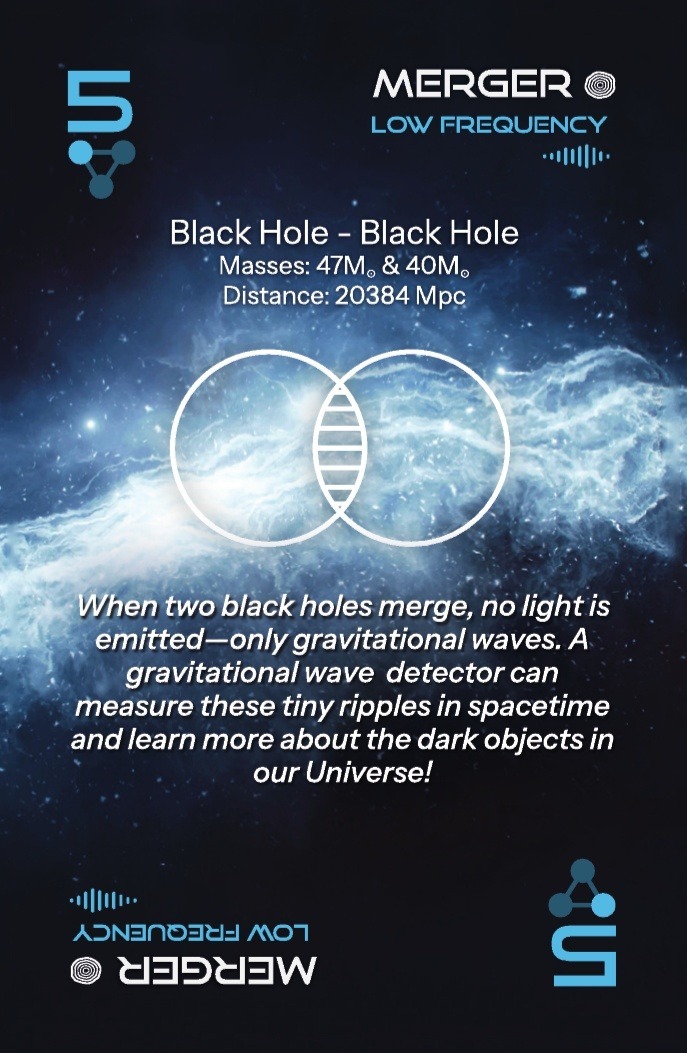
The noise level at a given frequency is of course different for the high-frequency and low-frequency detectors. This allows us to detect a whole range of different signals. For example, mergers of very heavy systems will more likely be detected with the low-frequency detector (blue cards), while the ringdown signal can only be measured with the high-frequency detector (red cards). It is therefore crucial to have both detectors up and running! Note that existing detectors can currently only detect high-frequency events.
Merger
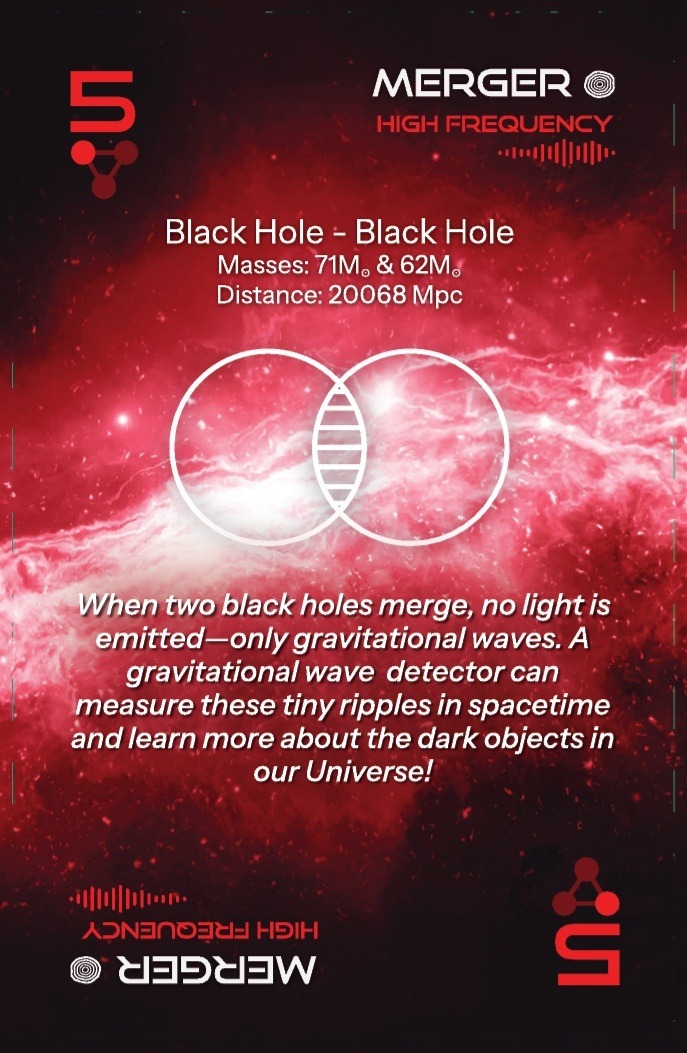
The only signals we can already listen to with gravitational waves today are mergers of compact objects: black holes or neutron stars. Neutron stars form when stars much heavier than the Sun burn up all their fuel at the end of their lives and implode. Neutron stars are incredibly small compared to how heavy they are: more than the mass of the Sun is packed into a sphere with a radius of just a few kilometers! Black holes are even more compact: they have squeezed their entire mass into a single point. The gravity around a black hole is so strong that nothing can escape it, not even light! Neutron stars and black holes curve the spacetime around them very strongly with their gravity. When two such objects meet and merge, they create large ripples in spacetime: gravitational waves.
The signal from a merger of two compact objects has a very recognizable shape: a long, low-frequency build-up that ends in a sudden chirp. This reflects the three phases of the merger. First, the objects move closer and closer together in a spiral orbit. Then they merge in a chaotic collision into a larger black hole, which loses its last energy by vibrating for a little while longer. The precise shape of the signal tells us about the properties of the two compact objects.
Supernova
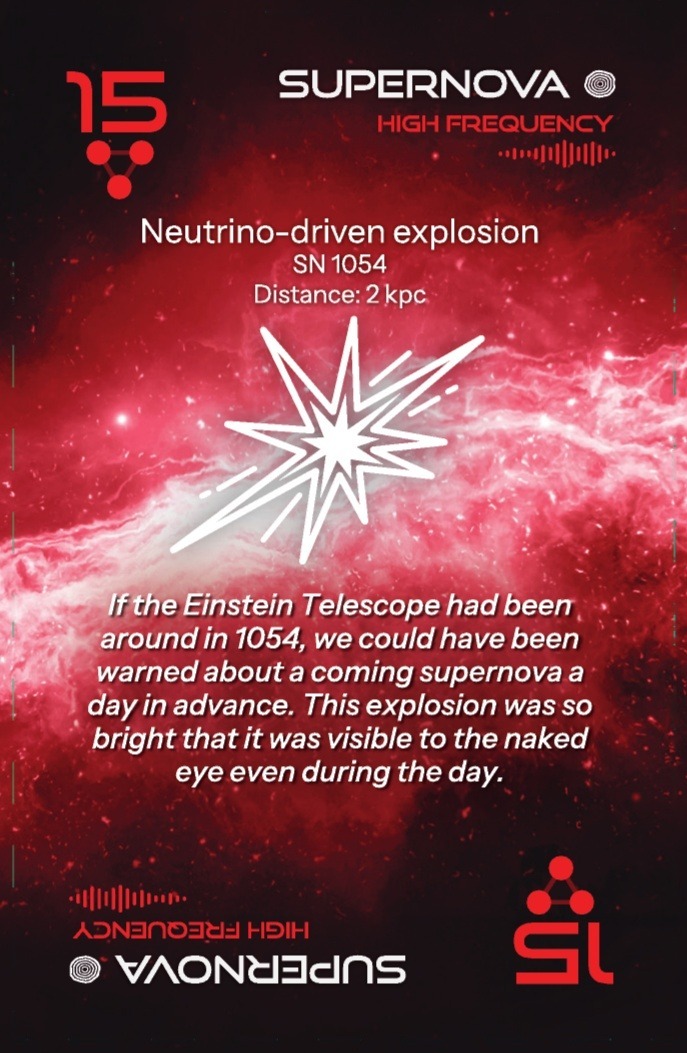
When a star implodes at the end of its life, this leads to a gigantic explosion: a supernova. These powerful explosions emit a lot of electromagnetic radiation, which we can observe with light telescopes if they happen relatively close to us. Yet we can learn much more about them if we can also listen to them with gravitational waves, because there is still a lot of uncertainty about the explosion mechanism. Stars that rotate quickly, for example, can use part of their rotational energy to power the explosion. This would produce a very loud gravitational wave, but we know of only a few stars that rotate quickly. Other stars have to power their explosion with energy deposited by neutrinos, which produces only a weak gravitational wave signal.
In both cases, the signal from a supernova is very different from that of a merger. First, the signal shows a short blip as the core of the star collapses within a few thousandths of a second. This is followed by a short period in which the shock wave collides with the middle layers of the star. Gradually, the newly formed neutron star starts to vibrate like a bell. As the explosion progresses, the neutron star shrinks, causing the frequency to rise. This whole process lasts only a few seconds, but afterwards the shock wave still has to force its way through the outer layers of the star. That is why we will only see the electromagnetic radiation (light) from a supernova a few hours or days after the gravitational wave signal.

Continuous Waves
Every compact object that is not perfectly round and spins around its own axis emits gravitational waves. Unfortunately, most objects in our universe are almost perfectly round, spin too slowly, or are not compact enough to emit detectable gravitational waves. A neutron star, on the other hand, can spin very fast if it forms from a rotating star. What's more, the matter in a neutron star is so densely packed that a grain of sand would weigh as much as the Great Pyramid of Giza. This makes it possible for the Einstein Telescope to detect tiny irregularities, such as mountains only 1 cm high. On Earth, we hear this type of gravitational wave as a continuous signal, like the siren of an ambulance.
Ringdown
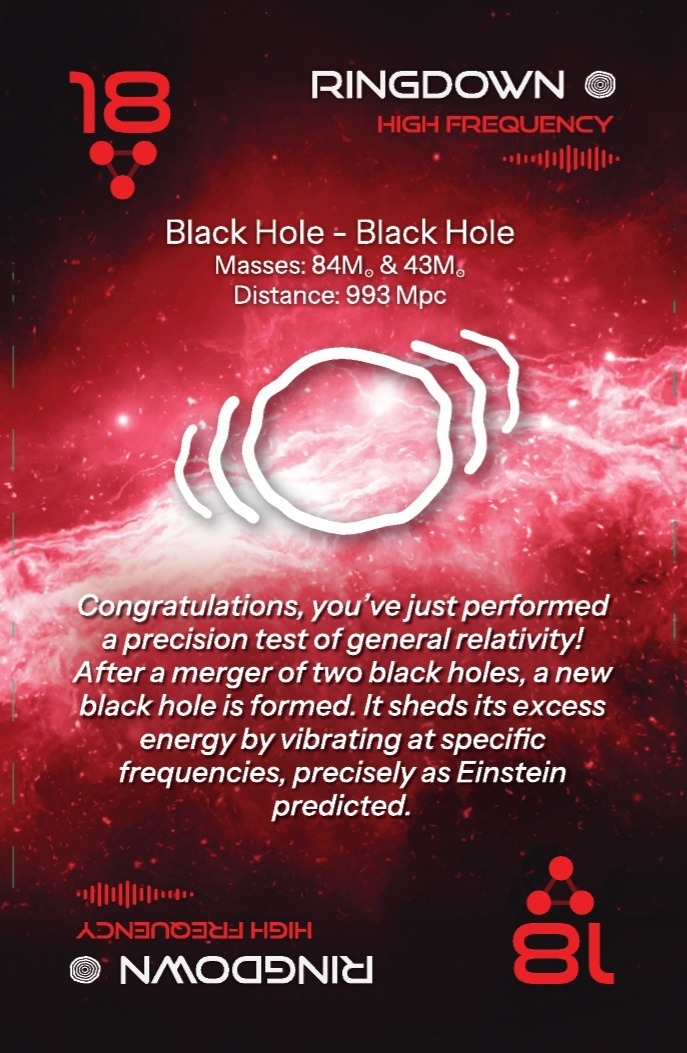
Just after two black holes have merged, the new black hole is not yet in equilibrium. As a result, it has excess energy, which it emits as gravitational waves by vibrating at specific frequencies. As the black hole loses energy, the strength of the gravitational waves also decreases. That is why we hear a fading, single-tone signal, like a glass you tap once. Theoretical physicists are very interested in the ringdown signal, because it is a powerful test of Einstein's theory of relativity. If we can measure the ringdown signal very precisely, we can check whether Einstein's theory describes black holes completely correctly.
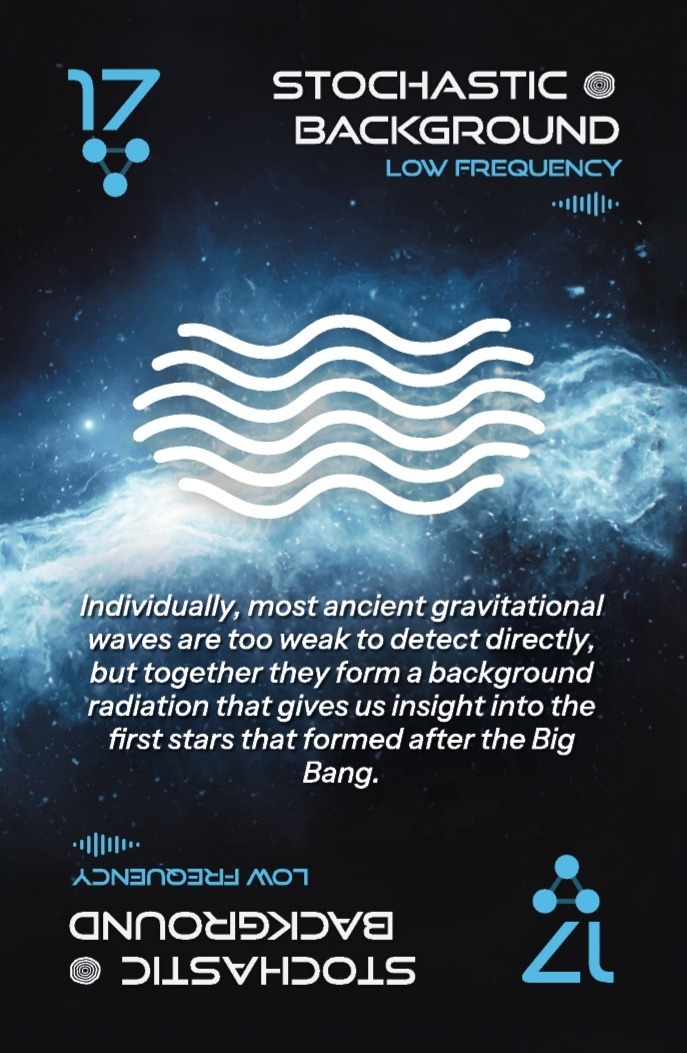
Stochastic Background
Powerful cosmic events such as black hole mergers and supernovae send out a clear, loud signal. But the universe also contains less powerful systems that emit quieter gravitational waves. These signals stand out less, but there are so many of them that together they form a constant background noise in the ears of the Einstein Telescope. Measuring this background can teach us something about the very first stars in the early universe, shortly after the Big Bang.